


Videos
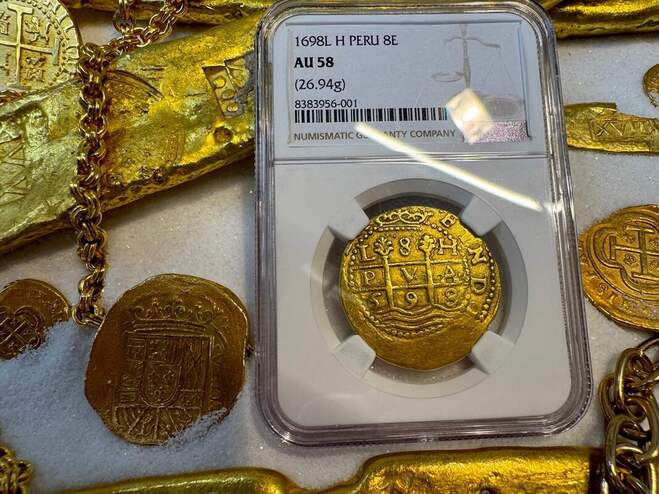
Crown of a Dying Dynasty: 1698 Lima Gold Cob 8 Escudos of Charles II – NGC AU 58, Finest Known****PERU, Lima, 1698-H. Gold Cob 8 Escudos. Assayer H. S-L25; KM-26.2; Cal-971; Fr-1. 26.94 grams. NGC AU 58
*T****op Pop and Only Example in Census. Plate Coin in Sedwick (4th ed.) and Calicó's La Onza.*
A monumental artifact from the twilight of Spain’s Habsburg empire, this 1698 Lima 8 Escudos gold cob is not only very rare, but pedigreed and plated in two major reference works, making it a true crown jewel of Spanish colonial numismatics. Boasting a bold full cross of Jerusalem flanked by lions and castles, a sharply defined pillars-and-waves motif on the obverse, and a legible C.II (for Carlos II) in the legend, this coin is the finest and only known example certified by NGC--a unique survivor of a turbulent imperial century.
Struck Under a Crumbling Crown: Charles II and the Final Habsburg Chapter
This piece was minted during the final years of the reign of King Charles II of Spain (r. 1665–1700), whose rule marked the waning light of the once-mighty Spanish Habsburg dynasty. Known to history as “El Hechizado” ("The Bewitched") due to his mysterious illnesses and deformities—likely the result of generations of inbreeding—Charles was more figurehead than sovereign. His reign was riddled with factionalism, economic decay, and imperial overstretch.
By 1698, Spain’s golden age had faded; the monarchy was plagued by instability and declining revenues. The once-dominant Spanish Armada had been weakened, and the treasure fleets were frequent targets of pirates and foreign powers. As Spain's overseas colonies continued to supply silver and gold, the minting of coins like this one was not just economic—it was a desperate assertion of royal authority.
This coin, therefore, is more than just currency; it’s a symbol of imperial inertia, minted in the New World as the Old World monarchy approached collapse. Upon Charles’ death in 1700 without an heir, the War of Spanish Succession would erupt, reshaping the balance of power in Europe and ending Habsburg Spain forever.
Minted in the Andes: Lima Mint and Assayer H
The Lima Mint, officially established in 1565 to exploit the mineral wealth of the Andes, had by the late 17th century become one of the most important producers of gold in the Spanish Americas. This specimen was struck by Assayer H (Cristóbal Cano Melgarejo), one of the most skilled officials of the period, whose work is renowned for its clarity and striking precision.
Although dated 1698, this coin is far rarer than the subsequent 1699 issue, with very few known survivors. Its presence in both Sedwick’s The Practical Book of Cobs (Plate Coin, page 83) and Calicó's La Onza (Plate Coin 111, page 65) further cements its significance as an object of intense scholarly and collector interest.
**Numismatic Significance and Condition
**Certified AU 58 by NGC, this example is not only top pop—it is the sole example on record, unmatched in the census. Its surfaces show only minor peripheral softness, common in hand-struck cobs, but the devices are impressively detailed: the full crown and doubled legends add personality, while the central design elements exhibit unusually strong strike fidelity for the type.
The legends, iconography, and bold composition all evoke the immense wealth being funneled from Peru's mines into Europe—even as the empire that demanded it began to unravel.
In sum, this coin is not just a rare cob—it’s a minted echo from the precipice of imperial collapse. A relic from the last years of Habsburg Spain, it speaks to the end of one world and the violent birth of another.
Peru 8 Escudos 1698 "1715 Fleet Shipwreck" NGC 58
$95,000.00